
Dan Beazley, left, holds a large cross as he prays with visitors at a memorial for flood victims on July 10 in Kerrville, Texas. Photo: Associated Press
[Episcopal News Service] A new presiding bishop completes an eventful first year, including reorganization of the churchwide staff to better serve dioceses. A new archbishop of Canterbury — the first woman — is chosen to lead the Anglican Communion at a time of rising tensions between some provinces. A new U.S. president takes office and upends governing norms, forcing church leaders to make tough decisions on how best to minister to and protect their communities.
Nearly from start to finish, 2025 was a momentous year for The Episcopal Church and the world it serves. Along the way, Episcopal News Service has reported the news, from big headlines to smaller updates and some stories that just make you go “hmm.”
In Texas and California, churches mobilized to respond to natural disasters. Numerous dioceses launched bishop searches, including a closely watched process in Florida. And a church property fight in New Jersey made news far beyond the congregation’s local community.
As we prepare to greet 2026, ENS is highlighting the following 10 stories from the past year. They include some of the most significant examples of The Episcopal Church at work in the world, and all 10 ranked among our top stories in pageviews. Several of them entailed ongoing coverage of evolving stories that will continue developing into the new near, so watch for continued coverage by ENS.
And look further below for a list of additional articles that resonated with our readers in 2025, from a Florida priest who teaches a course on ghosts and exorcisms to a Minnesota couple who bring a faith perspective to their personas as professional wrestlers.

Washington Bishop Mariann Budde preaches Jan. 21 at the Service of Prayer for the Nation at Washington National Cathedral. Photo: Washington National Cathedral, via Facebook
Washington bishop asks Trump to show mercy
There may have been bigger church news in 2025, but few stories seemed to resonate as loudly and widely for readers as Washington Bishop Mariann Budde’s sermon Jan. 21 at Washington National Cathedral’s Service of Prayer for the Nation.
With the newly inaugurated President Donald Trump in attendance, Budde addressed part of her sermon to the most powerful man in the room: “In the name of our God,” Budde said, “I ask you to have mercy upon the people in our country who are scared now.”
The reaction afterward was immediate and intense, with Trump and his supporters openly criticizing Budde while others in the church and across the country praised the bishop as a kind of folk hero for expressing their own fears at the start of the new administration.

Massachusetts Bishop Julia Whitworth prays with Blanca Martinez at a rally in September in Burlington before Martinez’s appointment with federal immigration officials. Photo: St. Peter’s-San Pedro Episcopal Church, via Facebook
Episcopalians mobilize to protect immigrants, LGBTQ+ Americans
Budde’s comments to Trump had singled out concerns raised by LGBTQ+ church members and immigrant communities. Within the first days of his presidency, some of those fears were realized.
The Trump administration began rolling back policies that it said were illegally promoting diversity, equity and inclusion, particularly related to transgender Americans. And the Department of Homeland Security ramped up immigration enforcement efforts and deportations to fulfill Trump’s promise of stricter policies toward both legal and illegal immigration.
Throughout the year, Episcopalians mobilized in their congregations, communities, dioceses and at the denominational level to protect vulnerable populations. More than 400 people attended a webinar in January on protecting transgender and nonbinary people, and Episcopalians showed renewed support for Pride Month in June, Transgender Day of Visibility in March and Transgender Day of Remembrance in November.
Several dioceses, from New York to Los Angeles, affirmed sanctuary policies toward immigrants as Trump’s immigration crackdown loomed, and throughout the year, many Episcopal churches have been involved in front-line response to U.S. Immigration and Customs Enforcement conducting immigration raids and arrests in numerous cities.
The Episcopal Church also joined an ecumenical lawsuit seeking to prevent enforcement officers from patrolling churches and other houses of worship without warrants. In addition, Presiding Bishop Sean Rowe and House of Deputies President Julia Ayala Harris issued a joint statement emphasizing “Christ’s call to welcome the stranger.”
And Rowe, at his ceremonial seating at Washington National Cathedral in February, preached against contemporary political divisions as “not of God” and lifted up immigrants, transgender people, the poor and other marginalized communities as central to the kingdom Jesus envisioned.
“God did not come among us as a strongman. God came among us as a child,” he said.

St. Michael’s Interfaith Refugee Resettlement Ministry at St. Michael’s, Brattleboro, Vermont, assisted Afghans arriving in the United States. That federal program was suspended in January by President Donald Trump. Photo: Lisa Sparrow
EMM ends decades-long refugee resettlement work
Trump’s shift in immigration policies was particularly decisive in gutting the federal refugee resettlement program that The Episcopal Church had helped facilitate for decades through the work of Episcopal Migration Ministries and its affiliates.
When the president on his first day in office suspended the refugee program, a form of legal immigration that has long held bipartisan support, EMM soon announced it was forced to lay off 22 employees and begin winding down that federal contract work.
Then in May, Rowe announced that the church would not participate in the Trump administration’s new plan to selectively classify certain white South Africans as refugees and welcome them into the United States as exceptions to his otherwise restrictive resettlement policies. The Episcopal Church formally ended all federal resettlement work when its contract expired at the end of the fiscal year, Sept. 30.
“It has been painful to watch one group of refugees [Afrikaners], selected in a highly unusual manner, receive preferential treatment over many others who have been waiting in refugee camps or dangerous conditions for years,” Rowe said in explaining the end of EMM’s federal work. EMM continues to support refugees and immigrants in other ways.
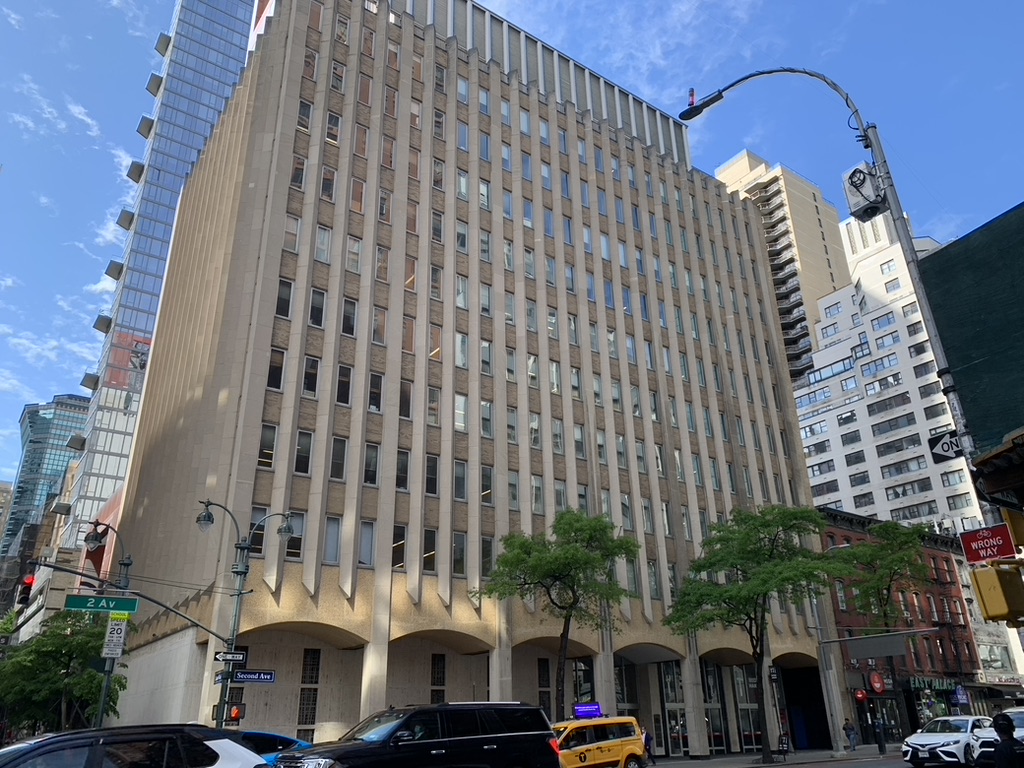
The headquarters of The Episcopal Church at 815 Second Avenue in New York City. Photo: Egan Millard/Episcopal News Service
Presiding bishop oversees church restructuring to serve dioceses
One of Rowe’s top priorities since taking office in November 2024 has been a reorganization of churchwide structures, including the denominational staff, partly in response to a cost-cutting mandate approved by the 81st General Convention as part of the church’s 2025-27 budget plan. Rowe also said he intended the reorganization to help fulfill his goal of better supporting and serving diocesan and congregational leaders as they follow Jesus’ call to spread the gospel and minister to their communities.
In February, Rowe issued a letter to the church summarizing a series of staff cuts, including 14 layoffs, as well as department reorganizations and changes to certain staff’s titles as he carries out the first phase of the realignment.
Since then, Rowe has continued to seek input on those and other structural changes from Executive Council, the church’s governing body between meetings of General Convention. The result was an estimated $2.5 million in annual savings on personnel starting with the budget that Executive Council approved in December for 2025.

The Diocese of Florida’s Camp Weed & Cerveny Conference Center in Live Oak, Florida. Photo: Camp Weed
Diocese of Florida looks to the future with new bishop search
In March, the Diocese of Florida, which has been without a diocesan bishop since October 2023, announced it was launching a new bishop search, after an ongoing healing process to address divisions that had festered in the diocese under former Bishop John Howard.
Previously, the diocese had twice tried to elect Howard’s successor, but those elections were successfully blocked by objections filed by some Florida clergy and lay leaders. A new election is now scheduled for September 2026.
Separately, Rowe moved to resolve two disciplinary cases against Howard under the church’s Title IV disciplinary canons for clergy. On Oct. 1, Rowe announced he had reached an accord with Howard without any disciplinary action and without Howard admitting any wrongdoing in the cases, which involved allegations of anti-LGBTQ+ discrimination and financial impropriety.
Rowe’s message also said that the 74-year-old Howard, independent of their agreement to end the cases, informed Rowe after he’d signed the accord that he wished to be released and removed from ordained ministry. Howard is no longer a bishop or clergy in The Episcopal Church.

Bishop Sarah Mullally was named as the 106th archbishop of Canterbury. She takes office in January. Photo: Associated Press
Sarah Mullally is first woman chosen to be archbishop of Canterbury
The Anglican Communion has been without an archbishop of Canterbury since former Archbishop of Canterbury Justin Welby resigned under pressure in a church scandal in January 2025.
The archbishop of Canterbury, in the historical role as head of the Church of England, is a kind of “focus of unity” and “first among equals” to archbishops and other primates in the 42 autonomous, interdependent global Anglican provinces, including The Episcopal Church.
In October, London Bishop Sarah Mullally was named as Welby’s successor, and when her election is confirmed in January 2026, she will become the first woman to assume that role.
“As I respond to the call of Christ to this new ministry, I do so in the same spirit of service to God and to others that has motivated me since I first came to faith as a teenager,” Mullally said. “I look forward to sharing this journey of faith with the millions of people serving God and their communities in parishes all over the country and across the global Anglican Communion.”

Bishops pose for their portrait during the Lambeth Conference on July 29, 2022. Photo: Egan Millard/Episcopal News Service
Conservative Anglicans threaten to leave Anglican Communion
Mullally will take office with a full plate of challenges before her. Foremost will be the fragile state of the Anglican Communion, with some conservative Anglican leaders threatening to split and form a kind of shadow communion that no longer accepts the archbishop of Canterbury as its “focus of unity.”
Two weeks after the Church of England announced Mullally as its next archbishop, the conservative Anglican network GAFCON, a mix of leaders from Anglican provinces and breakaway groups, released a statement saying it would disengage from the Anglican Communion’s existing deliberative bodies.
Some of those conservatives already had effectively boycotted Anglican meetings over theological disagreements on women’s ordination and LGBTQ+ inclusion. So far, there has been little evidence of a groundswell of support for expanding that boycott.
A key test of Anglican unity could come, however, in June and July 2026, when the Anglican Communicative Council is scheduled to convene its next meeting in Belfast, Northern Ireland. Proposed reforms to the Anglican Communion’s structures, known as the Nairobi-Cairo proposals, are expected to be discussed thoroughly.

The Rev. Bert Baetz leads a dedication ceremony in Hunt, Texas, for an RV purchased by St. Peter’s Episcopal Church in Kerrville for use as a mobile relief unit in the aftermath of the July 4 Hill Country flood. Photo: Lauren Vereen/St. Peter’s Episcopal Church
Dioceses of Texas communities are devastated by deadly flash floods
More than 100 people were killed July 5 when flash flooding from the rain-swollen Guadalupe River overwhelmed communities in the Texas Hill Country, particularly in Kerr County.
Episcopalians from St. Peter’s Episcopal Church in Kerrville were among the dead, and the congregation immediately opened its doors to mourners, began raising money for relief and recovery efforts and provided additional support to its community alongside ecumenical and secular partners.
“It was all hands on deck,” the Rev. Bert Baetz, St. Peter’s rector, told ENS in August, describing his community’s emergency response during and immediately after the disaster. The stories of survival were harrowing, yet also somehow filled with hope, and the congregation leaned into that hope as Kerr County looks to the future.

The congregation of St. Mark’s Episcopal Church in Altadena, California, gathers Jan. 19 for its first Sunday worship service at nearby St. Barnabas Episcopal Church in Eagle Rock after the St. Mark’s church and school buildings burned down earlier in the month. Photo: Matt Wright.
Urban wildfires level whole neighborhoods in Diocese of Los Angeles
An Episcopal church in Altadena, California, and two rectories in Pacific Palisades were among the more than 1,000 structures that were destroyed in January by a series of wind-fueled California wildfires that devastated communities across Los Angeles County.
In the worst hotspots, the deadly fires left some neighborhoods in smoldering ruins, as the Diocese of Los Angeles mobilized to assist and console the victims.
Episcopalians will do “our Gospel work of banding together in faith,” Los Angeles Bishop John Harvey Taylor said in a message to the diocese. “God bless all who’ve reached out to offer shelter and other resources for evacuees.”

Members of Christ Episcopal Church in Toms River, New Jersey, urge drivers to help the parish fight the mayor’s planned land grab. Photo: Courtesy of Denise Henry
New Jersey church fights back against mayor’s eminent domain threats
One of the most unusual and unexpected Episcopal stories of 2025 involved Christ Episcopal Church in Toms River, New Jersey. The congregation’s efforts to create a 17-bed overnight shelter on church property to serve people experiencing homeless raised objections from neighbors and some elected officials.
While that plan was under consideration, Toms River Mayor Daniel Rodrick announced in April a plan to seize the church’s 11 acres and five other privately owned lots for parkland, either through purchase or by eminent domain. That plan sparked an outcry from church leaders and their supporters, while legal experts suggested the church was on solid ground if the matter were to escalate into a court battle.
Eventually, Rodrick backed down, saying in August he was dropping his plans to turn Christ Episcopal into parkland. The church also gave up its effort to open an overnight shelter there.
Other top ENS headlines from 2025
- South Dakota bishop apologizes to for diocese’s involvement in Indigenous boarding schools
- Religious leaders welcome Gaza ceasefire, lament Israel’s imprisonment of Anglican Palestinian
- Episcopal priest teaches course on church and ghosts, exorcisms
- House of Bishops, Dominican Episcopalians worshipping together was ‘worth the wait’
- Council of Nicaea’s decisions 1,700 years ago affect today’s church
- William Barber arrested in Capitol Rotunda after praying against Republican-led budget
- San Diego diocese, partners open migrant shelter for women and children in Tijuana
- Missouri congregations move US flags from altars as church condemns Christian nationalism
- Minnesota couple relies on their Episcopal faith as they serve their local wrestling community
- Fort Worth church purchases property for new home 4 years after eviction by ACNA
- From a South Korean base, Episcopal Army chaplain performs unique, multifaceted duties
- Jimmy Carter remembered by President Biden at National Cathedral funeral
- Michigan church to take part in citywide ‘Gilmore Girls’-themed weekend
– David Paulsen is a senior reporter and editor for Episcopal News Service based in Wisconsin. He can be reached at dpaulsen@episcopalchurch.org.